Tuesday, February 18, 2014

14 Feb 2014 AMC - Market ended on a higher note on Valentine's Day!


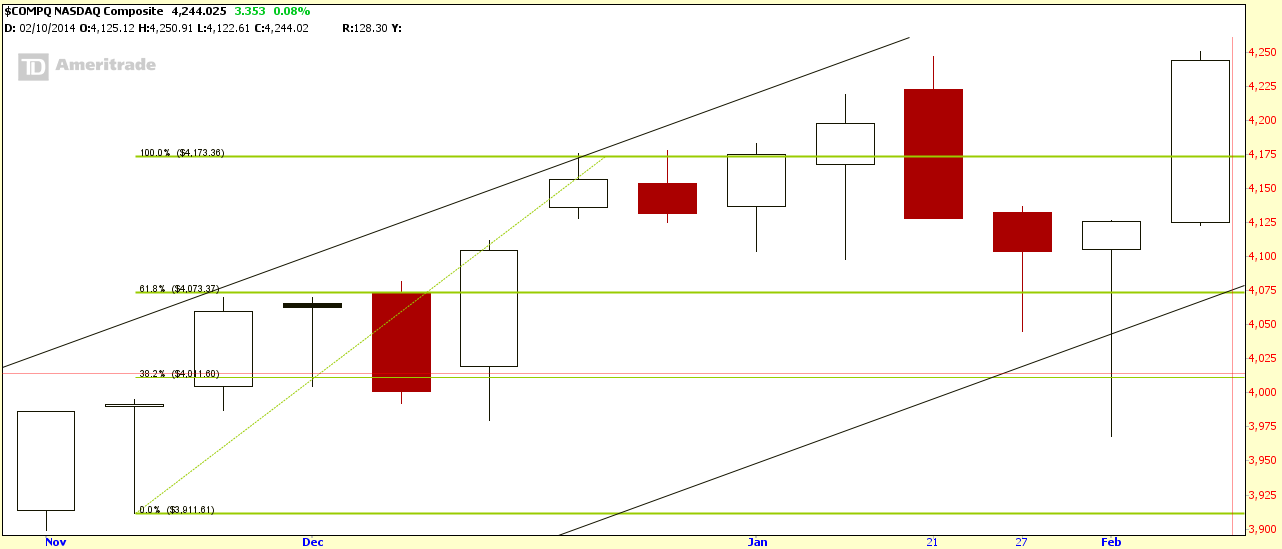
The stock market ended an upbeat week on a positive note. The Dow Jones Industrial Average (+0.8%) paced the advance while the S&P 500 gained 0.5%. The Nasdaq (+0.1%) lagged, but was able to finish at its highest level since late 2000. 

Today's advance capped an impressive week during which the benchmark S&P 500 gained 2.3%. Even though stocks rallied sharply, it is worth noting that all five sessions of the week saw below-average volume while bellwether groups like financials and transports struggled to keep pace with the broader market. The financial sector added just 0.2% on Friday, extending its weekly gain to 1.6%. For its part, the Dow Jones Transportation Average (+0.3%) added 0.9% for the week. 

Similar to financials, other top-weighted sectors like health care (+0.4%) and technology (+0.2%) lagged while consumer discretionary (+0.6%), energy (+1.5%), industrials (+0.7%), and materials (+0.7%) picked up the slack. 

The energy sector drew considerable strength from its largest member, ExxonMobil (XOM 94.11, +2.68), which surged 2.9%. The Dow component regained its 100- and 200-day moving averages in a move that was aided by an ISI Group upgrade to ‘Buy' from ‘Neutral.' On a related note, crude oil ended little changed at $100.29/bbl. 

Elsewhere among commodities, precious metals remained on a torrid pace. Gold futures posted their seventh day of gains, climbing more than 5.0% in that timeframe. Meanwhile, silver capped an eight-day run that saw the metal jump nearly 8.0%. This translated into another strong session for gold miners as the Market Vectors Gold Miners ETF (GDX 26.35, +0.48) rose 1.9%. 

Mining shares contributed to the outperformance of the materials sector, which also benefitted from gains among steelmakers after Cliffs Natural Resources (CLF 23.16, +1.26) reported better-than-expected results. 

Staying on the earnings theme, apparel retailer V.F. Corp (VFC 56.85, -3.04) slumped after announcing disappointing results and issuing a profit warning. The stock tumbled 5.1%, which kept a lid on its peers. The rest of the discretionary sector held up well with help from homebuilders. The iShares Dow Jones US Home Construction ETF (ITB 25.21, +0.28) rose 1.1%. 

Interestingly, builder shares outperformed even as Treasury yields inched higher. The benchmark 10-yr yield rose one basis point to 2.74% after ending last week at 2.68%. 

As mentioned earlier, trading volume was well below average with only 609 million shares changing hands at the NYSE. Today's final tally represented the lowest total since January 3. 

Today's economic data included three reports: 
  • Export prices, excluding agriculture, ticked up 0.2% in January after increasing 0.3% in the prior reading. Excluding oil, import prices rose 0.3%, which follows last month's downtick of 0.1%. 
  • Industrial production declined 0.3% in January after increasing 0.3% in December while the Briefing.com consensus expected an increase of 0.3%. Once again, the hard economic data did not mesh with the results in the ISM report and the related regional surveys. Those reports showed solid, albeit slightly unsteady production levels in January. Instead of translating into slightly positive growth, however, actual manufacturing production fell 0.8% in January. That was the largest drop since May 2009. Making matters worse, manufacturing production growth was revised down for each month going back to October. After the revisions, fourth quarter manufacturing production only increased 4.2%, down from an originally reported gain of 6.2%. This comes after the ISM Production Index was recorded above 60 during that entire time, suggesting manufacturers are definitely not doing what they are saying in the surveys. The motor vehicle sector was hit especially hard in January. Assemblies fell by 1.0 million, from 11.64 million in December to 11.62 million in January. 
  • The preliminary reading for the University of Michigan Consumer Sentiment Index for February was unchanged at 81.2 while the Briefing.com consensus expected the index to fall to 80.2. The Current Conditions Index weakened slightly, falling from 96.8 in January to 94.0. This was offset by an increase in the Expectations Index from 71.2 to 73.0 in February. 
Bond and equity markets will be closed on Monday for Presidents' Day. 
  • Nasdaq Composite +1.6% YTD 
  • S&P 500 -0.5% YTD 
  • Russell 2000 -1.1% YTD 
  • Dow Jones Industrial Average -2.6% 


Market Internals


Leaders & Laggards


Technical Updates


Weekly Updates


Next week in view


Alvin's commentary:

The market headed higher on Valentine's day! The Valentine's Day indicator has a 100% reliability over the last 25 years! Market started with a slight bearish tone and crawl its way back to end positive, perhaps an indication of the whole 2014 if the Valentine's Day indicator were to continue to be 100% accurate. Most notable is Nasdaq which struggle to stay positive and only manage to break positive at around 2pm. 

Market Call: UP
Date: 18 Feb 2014

Friday, February 14, 2014

13 Feb 2014 AMC - Market ended positive despite bad start


The stock market rallied steadily throughout the trading day despite starting the session on a lower note. Small caps led the way with the Russell 2000 climbing 1.3% while the S&P 500 advanced 0.6%. 

The benchmark index was down as much as 0.6% at the start of the session after overnight weakness in the futures market set the stage for a lower open. The losses in futures coincided with a wave of yen strength that once again stoked fears about potential forced unwinds of the yen-based carry trade. Adding to the early weakness was a disappointing retail sales report for January. 

Even though stocks opened lower, the S&P 500 found support at its 50-day moving average in the 1810 area. The index also drew strength from the retreat in the yen as the dollar/yen pair climbed off its low just under the 101.75 level. 

Strikingly, the rally in equities continued even as the dollar/yen pair spent the afternoon in a narrow range while Treasuries never surrendered their morning gains. In fact, the 10-yr note extended its morning advance, sending its yield lower by six basis points to 2.73%. 

It should be noted that the advance in equities took place amid below average volume, which could have exacerbated movements in some prices. Only 627 million shares changed hands at the NYSE floor versus a 200-day average of 717 million. 

All ten sectors posted gains with materials (+1.0%) and utilities (+1.2%) ending in the lead. The rate-sensitive utilities sector benefited from the retreat in yields while materials drew strength from steelmakers and miners. The Market Vectors Steel ETF (SLX 47.05, +0.44) gained 0.9% while Market Vectors Gold Miners ETF (GDX 25.87, +1.10) jumped 4.4%. On a related note, gold futures rose 0.4% to $1300.40/ozt, ending above the $1300.00 mark for the first time since early November. 

Elsewhere, the largest S&P 500 sector, technology (+0.9%) shook off the disappointing guidance provided by Cisco Systems (CSCO 22.27, -0.58), and rallied on the back of chipmakers. NVIDIA (NVDA 17.36, +0.53) gained 3.2% in reaction to its above-consensus results while the broader PHLX Semiconductor Index settled higher by 1.2%. 

Other heavily-weighted groups were mixed with respect to the broader market. Health care (+0.8%) outperformed while consumer discretionary (+0.4%), energy (+0.4%), financials (+0.4%), and industrials (+0.2%) lagged. 

Looking back at the economic data: 
  • Retail sales fell 0.4% in January after declining a downwardly revised 0.1% (from +0.2%) in December. The Briefing.com consensus expected no growth in January. The report was discouraging and many are going to point to extreme winter weather conditions as the primary cause for the larger-than-expected decline. That scenario holds some truth as sectors that are normally affected by weather conditions such as motor vehicle sales (-2.1%) and restaurants (-0.6%) saw significant pullbacks. However, spending in general was weaker across the board. That could signal that the spending out of savings that occurred in December was a one-time event related to the holidays and not the start of a new trend. 
  • The weekly initial claims level increased to 339,000 from an unrevised 331,000 while the Briefing.com consensus expected an increase to 335,000. The claims data have shown some choppiness, likely the result of volatility from the extreme winter weather conditions. In general, claims have not deviated from its 330,000 - 340,000 trend. These levels normally support payroll growth in the neighborhood of 185,000 - 200,000 jobs per months. 
  • Business inventories increased 0.5% in December after increasing 0.4% in November while the Briefing.com consensus expected an increase of 0.4%.Total inventories consist of manufacturers, merchant wholesalers, and retails. Both manufacturers (0.5%) and wholesaler (0.3%) inventories were announced prior to the total inventory release. The only unknown was retailer inventories, which increased 0.6% in December after increasing 0.8% in November. 
Tomorrow, January export prices ex-agriculture and import prices ex-oil will be released at 8:30 ET while Industrial Production and Capacity Utilization for January will be announced at 9:15 ET. The day's data will be topped off by a 9:55 ET release of the preliminary Michigan Consumer Sentiment survey for February. 
  • Nasdaq Composite +1.5% YTD 
  • S&P 500 -1.0% YTD 
  • Russell 2000 -1.3% YTD 
  • Dow Jones Industrial Average -3.3% YTD

Market Internals


Leaders and Laggards


Technical Updates


Next day in view


Alvin's commentaries

Wooh .. where did that come from? Futures were down, Core retail sales report and Unemployment claim is down but the market just went up after the first 15 mins of sell down. Tomorrow we will have the Valentine's Day indicator.

12 Feb 2014 AMC- Market taking a break after 4 bull run

Market Summary


Equity indices took a bit of a breather on Wednesday after the S&P 500 surged nearly 4.5% in the six sessions since February 3. The benchmark index shed less than a point while the Dow Jones Industrial Average slipped 0.2%.

Overall, the session was very quiet as the key averages respected narrow ranges. The S&P 500 spent the bulk of the trading day near its flat line while the Nasdaq (+0.2%) outperformed.

Similar to the major averages, most individual sectors never deviated too far from their unchanged levels. The largest S&P 500 sector, technology (+0.3%), finished in the lead thanks to chipmakers. Intel (INTC 24.55, +0.08) added 0.3% while the broader PHLX Semiconductor Index rose 0.9%.

Outside of technology, consumer discretionary (+0.1%) and industrials (+0.2%) were the only other advancers among cyclical groups. Defense contractors outperformed (PHLX Defense Index +0.5%) while Deere (DE 86.90, -0.56) fell 0.6% despite beating on earnings and revenue.

Also of note, two of yesterday's leaders—energy (-0.4%) and materials (-0.3%)—finished among today's laggards. However, the pair still fared a bit better than the consumer staples sector, which lost 0.5% as tobacco names lagged after Lorillard (LO 47.47, -2.48) reported disappointing earnings.

Other countercyclical groups were little changed with telecom services (+0.3%) ending modestly higher while health care (-0.1%) and utilities (-0.1%) finished in the red.

Treasuries posted their third day of losses as the 10-yr yield rose three basis points to 2.76%. Interestingly, the retreat in one safe-haven asset was accompanied by an increase in another. Gold futures saw their fourth day of gains, climbing 0.4% to $1294.90/ozt.

Today's participation was well below average as less than 630 million shares changed hands at the NYSE.

Economic data was limited to just two reports: 
·         The weekly MBA Mortgage Index slipped 2.0% to follow last week's uptick of 0.4%. 
·         January Treasury Budget showed a deficit of $10.40 billion, which followed the prior month's surplus of $2.90 billion. The Briefing.com consensus expected the deficit to hit $10.00 billion. 

Among overseas news of note, Italian Prime Minster Enrico Letta held a press conference amid increasing calls for his resignation, making way for the leader of the Democratic Party, Matteo Renzi. In his remarks, Mr. Letta asked for ‘clarity,' saying, ‘He who wants to replace me must be clear about his intentions.' Even though the political future of Italy remains uncertain, Italian stocks appeared unconcerned with the situation as the MIB gained 1.3%.

Tomorrow, weekly initial claims and January retail sales will be reported at 8:30 ET while the December Business Inventories report will cross the wires at 10:00 ET. Also of note, Fed Chair Janet Yellen was scheduled to appear before the Senate Banking Committee for the second part of the semiannual testimony on monetary policy, but the hearing has been postponed due to weather.

·         Nasdaq Composite +0.6% YTD
·         S&P 500 -1.6% YTD
·         Russell 2000 -2.5% YTD
·         Dow Jones Industrial Average -3.7% YTD

Market Internals


Leaders & Laggards


Technical Updates


Next Day in view


Alvin's commentaries


Late in doing dma today. Unemplyment claim went up which is bad news and core retail sales gone down which is more bad news. Technicals showing sign of reversals. I reckon it's a bear day today.


Market Call : Down
13 Feb 2014

Thursday, February 13, 2014

11 Feb 2014 AMC- Market Rally as Yellen speaks

Market summary


The stock market rallied steadily throughout the Tuesday session with the Dow Jones Industrial Average (+1.2%) providing the lead. Thanks to the advance, the Dow narrowed its 2014 loss to 3.5% while the Nasdaq (+1.0%) was able to swing from a loss to a year-to-date gain of 0.4%. The S&P 500 (+1.1%) regained its 50-day moving average with all ten sectors contributing to the climb. 

Heading into the session, many participants were anxious to hear Janet Yellen's first testimony as the new Fed Chair, but the lengthy appearance before the House Financial Services Committee was largely uneventful. 

Like her predecessor, Ms. Yellen indicated the Fed plans to remain data dependent in its decision making and that measured tapering will continue unless economic data takes a turn for the worse. When asked about the impact of the disappointing jobs reports for December and January on the Fed's reaction function, Ms. Yellen said it would be premature to alter policy based on a limited sample size. 

In other news from Washington, all signs pointed to the House of Representatives being ready to pass an unconditional bill to raise the debt ceiling, which likely contributed to the market's sunny disposition. 

All ten sectors took part in today's advance with energy (+1.4%) and materials (+1.2%) ending in the lead. The energy sector drew strength from top components like Chevron (CVX 113.58, +1.89) while crude oil ended little changed at $99.95 per barrel. 

Elsewhere, the materials space received significant support from miners. Royal Gold (RGLD 65.20, +2.66) and Randgold Resources (GOLD 77.08, +2.55) posted respective gains of 4.3% and 3.4% while the broader Market Vectors Gold Miners ETF (GDX 25.65, +0.95) jumped 3.9% and regained its 200-day moving average. On a related note, gold futures rose 1.2% to $1289.70 per troy ounce. 

With regard to other growth-sensitive sectors, technology (+1.2%) and industrials (+1.1%) outperformed while consumer discretionary (+0.7%) and financials (+1.0%) lagged. 

On the countercyclical side, health care and telecom services both gained 1.3% while consumer staples and utilities added 1.1% and 0.9%, respectively. 

Treasuries ended on their lows with the 10-yr yield up four basis points at 2.72%. 

Despite the broad rally, trading volume was below average as less than 700 million shares changed hands at the NYSE. 

Today's economic data was limited to December wholesale inventories, which increased 0.3% after increasing 0.5% in November. The Briefing.com consensus expected an increase of 0.6%. The BEA assumed merchant wholesaler inventories rose 0.6% in December when calculating the advance fourth quarter GDP report. The lower-than-expected increase in wholesale inventories will result in a negative revision to fourth quarter GDP growth. 

Tomorrow, the weekly MBA Mortgage Index will be reported at 7:00 ET while the January Treasury budget will be released at 14:00 ET. 
  • Nasdaq Composite +0.4% YTD 
  • S&P 500 -1.6% YTD 
  • Russell 2000 -2.9% YTD 
  • Dow Jones Industrial Average -3.5% YTD


Market Internals


Leaders & Laggards


Technical Updates

Next day in view


Alvin's Commentaries:

In Options Module 1 Class. ThinkOrSwim unable to load prophet chart. 

Monday, February 10, 2014

10 Feb 2014 AMC- Market moves sideways ahead of Yellen's testimony

Market Summary


The stock market began the new trading week on a subdued note. The Dow Jones Industrial Average, Nasdaq, and S&P 500 posted gains between 0.1% and 0.5% with the Nasdaq Composite ending in the lead. 

Overall, the session had a ‘wait-and-see' feel as many participants stuck to the sidelines ahead of tomorrow's Humphrey-Hawkins testimony on monetary policy. Although Fed Chair Janet Yellen is expected to strike a similar tone to the latest FOMC policy statement, the testimony will be the first public appearance for the new Fed Chair. Janet Yellen's prepared remarks will be released at 8:30 ET while the Q&A before the House Financial Services Committee is scheduled to begin at 10:00 ET. 

The limited participation was reflected in today's trading volume as only 640 million shares changed hands at the NYSE. In fact, the final tally marked the lowest daily volume since January 28. 

Seven out of ten sectors posted gains with health care (+0.9%) ending in the lead. The group outperformed throughout the session thanks in part to the relative strength of biotechnology. The iShares Nasdaq Biotechnology ETF (IBB 250.72, +4.39) advanced 1.8% and also provided support to the Nasdaq Composite. 

Like health care, the remaining countercyclical sectors also finished in the green, posting gains between 0.4% and 0.7%. 

Things were a bit more mixed on the cyclical side where financials (+0.1%), technology (+0.3%), and materials (+0.4%) outperformed while consumer discretionary (-0.04%), energy (-0.6%), and industrials (-0.6%) lagged. 

Notably, the industrial sector was pressured by broad weakness among transports. The Dow Jones Transportation Average fell 1.0% as 17 of its 20 components ended in the red. The bellwether complex lagged for the second consecutive session after coming up short of its 50-day moving average (7272) on Friday. 

Elsewhere, the energy sector finished behind the remaining groups as large components like Chevron (CVX 111.69, -0.36) and ExxonMobil (XOM 89.52, -1.06) lagged. The two Dow members lost 0.3% and 1.2%, respectively. 

Treasuries settled modestly higher with the 10-yr yield off one basis point at 2.67%. 

Tomorrow, the wholesale inventories report for December will be released at 10:00 ET. 
  • Nasdaq Composite -0.7% YTD 
  • S&P 500 -2.6% YTD 
  • Russell 2000 -3.7% YTD 
  • Dow Jones Industrial Average -4.7% YTD

Market Internals


Leaders & Laggards


Technical Update


Next Day in View


Alvin's commentaries

Last night things are going sideways, perhaps waiting to see what Yellen is going to say. Market internals shows that it was divergence everywhere, TRIN up while VIX down. As usual, market started with some bearish bias (futures were down before opening bell) and reversed around 10am till the closing bell to end flat. Everyone is on a 'wait and see' attitude now. Based on the weekly technical candle (bullish reversal hammer pattern), Yellen's speech tonight could just be the catalyst to do that.


Market Call: Up
Date: 11 feb 2014

7 Feb 2014 - Market rallied despite poor jobs data


Market Summary

The major averages finished a shaky week on an upbeat note. The Nasdaq led the way, climbing 1.7% while the Dow Jones Industrial Average and S&P 500 added 1.1% and 1.3%, respectively. Thanks to the broad rally, the indices managed to register weekly gains between 0.5% and 0.8% but small caps were not as fortunate. The Russell 2000 gained 1.1%, trimming its weekly loss to 1.3%. 

Prior to the open, it was reported that only 113,000 nonfarm payrolls were added in January while the Briefing.com consensus expected an increase of 175,000. Immediately after the release, equity futures and the dollar/yen pair tumbled while gold futures and Treasuries rallied. Strikingly, the moves reversed nearly as fast after the dollar/yen pair surged off its low near the 101.50 level. 

Once again, the rebound in dollar/yen occurred in conjunction with the rebound in futures and continued into the session. This suggests participants remain very sensitive to the performance of the Japanese currency due to the popularity of the yen-based carry trade that benefits from rising stocks and a falling yen. 

An interesting component of today's rally in the stock market, which was presumably predicated on the belief that pent-up demand will unleash better labor market and economic data in coming months, was that the Treasury market also traded higher. The benchmark 10-yr note added four ticks, pressuring its yield to 2.68%. The growth acceleration view, therefore, did not appear to be resonating as much in the fixed income market as it did in the stock market. 

In the same vein, the US Dollar Index (DXY 80.65, -0.25) slipped today in a move that didn't exactly mesh with the stock market's seeming optimism about the road ahead. Also of note, gold futures rose 0.5% to $1262.90/ozt. 

Just like yesterday, cyclical sectors paced the bulk of the advance. All six growth-sensitive groups posted gains between 1.1% and 1.6% with industrials ending in the lead. The sector drew strength from the likes of Boeing (BA 127.02, +4.35) and Honeywell (HON 93.16, +2.02) while transports lagged. The Dow Jones Transportation Average surged at the open and tested its 50-day moving average (7272) before surrendering a portion of the advance. The bellwether complex ended higher by 0.8% after being up nearly 1.2% in the morning. 

Elsewhere among cyclical sectors, the discretionary space advanced 1.3%, extending its weekly gain to 1.9%. The discretionary sector ended the week ahead of the remaining nine groups after losing nearly 6.0% in January. 

On the defensive side, health care (+1.7%) seized the lead during the afternoon while the remaining three countercyclical groups—consumer staples (+0.9%), telecom services (+0.7%), and utilities (+0.6%)—lagged. Biotechnology contributed to the outperformance of the health care sector as the iShares Nasdaq Biotechnology ETF (IBB 246.33, +9.54) surged 4.0%. 

Participation was a bit above average as 751 million shares changed hands at the NYSE. 

Today's data was limited to just two reports: 
  • Nonfarm payrolls added only 113,000 jobs in January. That was up from a 75,000 (from 74,000) gain in December, but well below the Briefing.com consensus expectation of a 175,000 gain. Even though the claims data have shown improvements in labor conditions and a clear decline in layoff trends, it has not translated into employers hiring more workers. The labor market is stuck in the mud. Many analysts will be quick to blame the poor data on extreme cold and other problematic weather conditions, but if this was the case then jobs that are directly affected by the weather-such as construction-should have fallen in January. That did not happen. The construction sector actually added 48,000 new jobs in January, which was the most new jobs since 80,000 jobs were added in March 2007. Total private payrolls added 142,000 jobs in January, up from an 89,000 gain in December. The consensus expected private payrolls to increase by 161,000. The unemployment rate fell to 6.6% from 6.7% while the consensus expected the rate to remain at 6.7%. 
  • The consumer credit report for December showed credit growth of $18.80 billion while the Briefing.com consensus expected the reading to come in at $11.50 billion. The prior month's reading was revised higher to $12.40 billion from $12.30 billion. 


Market Internals


Leaders and Laggards


Technical Updates


Weekly Analysis


 Next Week in View


Alvin's commentaries

The market manage to close Friday on a positive note (>1%) and end the week positive too. This create a hammer candlestick on the weekly chart which is a bullish reversal pattern, perhaps signifying more upsides this week. 

 Market Call: UP
Date:10 Feb 2014